The Importance of Temperature Control in Smoking Meat
Good barbecue starts with steady heat. In the barbecue world, consistent warmth lets collagen break down and fat render slowly, producing tender,…
Good barbecue starts with steady heat. In the barbecue world, consistent warmth lets collagen break down and fat render slowly, producing tender, juicy meat and deep smoky flavor.
Built‑in lid gauges often read dome air, not grate-level heat. Trust a reliable probe at the grate to know the real conditions where food cooks. That small difference matters for both safety and final results.
Practical habits make a big impact: preheat the cooker, keep fuel additions measured, use a water pan to steady heat and humidity, and avoid frequent lid openings that dump heat and smoke.
When fluctuations are minimized, the cooking process becomes predictable. That means fewer surprises, safer internal targets, and a better shot at near-perfection each time you fire up your smoker or grill.
Key Takeaways
- Steady heat breaks down collagen and renders fat for tender, flavorful meat.
- Use grate-level probes; dome thermometers can be misleading.
- Preheat, manage fuel, and limit lid lifts to reduce temperature swings.
- A water pan helps buffer heat and preserve surface moisture.
- Consistent practice turns good barbecue into repeatable perfection.
Why Temperature Control Matters for Tender, Flavorful BBQ
A steady cooking environment turns tough cuts into tender, sliceable perfection. Low‑and‑slow heat gives collagen time to break down while fat slowly renders, producing texture and deep flavor.
Safe doneness comes from hitting internal targets without overshooting. Probes and probe feel help you stop cooks when meat is tender but still juicy. That reduces food loss and keeps servings consistent.
Stable settings also cut guesswork. Predictable run rates let you plan rests and service windows, saving time and improving final results. Small vent nudges change behavior; big moves cause swings.
- Steady heat dissolves collagen and renders fat for juicy slices.
- Clean airflow through slightly open vents yields thin blue smoke and balanced taste.
- Track pit and meat temps to adjust before stalls and protect moisture.
| Focus | Benefit | Practical Tip |
|---|---|---|
| Tenderness | Soft, sliceable texture | Keep even heat; avoid frequent lid lifts |
| Food Safety | Safe internal doneness | Use calibrated probes for meat and pit |
| Efficiency | Predictable cook times | Fine‑tune vents and monitor rate of rise |
How to Control Temperature in a Smoker: Tools, Airflow, Fuel, and Smoke Management
Not all gauges tell the same story—probe placement and device accuracy matter most. Use a calibrated digital probe at grate level to read true pit conditions. Built‑in lid thermometers often mislead, so dual probes and high/low alarms help you track both pit and meat.
Smart monitors and automation
Wi‑Fi and Bluetooth units like FireBoard 2 and ThermoWorks Signals log temps and send alerts. Weber Connect adds step guidance for cooks. Automatic controllers such as BBQ Guru meter oxygen with a small fan to keep steady heat.
Airflow, vents, and fuel
Think of vents as lungs: intake brings oxygen; exhaust creates draft. Start with exhaust half open and intake a quarter, then make tiny adjustments. Seal gaps, clean sliders, and use a charcoal chimney to build a steady lump bed.
Smoke and stability
Prefer natural lump charcoal and quality wood chunks. Aim for thin blue smoke by placing chunks to smolder, not flare. Add a water pan, preheat fully, and avoid frequent lid lifts to preserve a stable cooking environment.
- Quick tips: place grate‑level probes, keep vents smooth, use a chimney, and favor lump over briquets.
Target Temperatures, Cooking Times, and Smoke Profiles for Popular Cuts
Different cuts demand different run rates and internal targets for best results. Use the ranges below as a roadmap, then confirm doneness by probe feel and rest time.
Brisket and pork shoulder
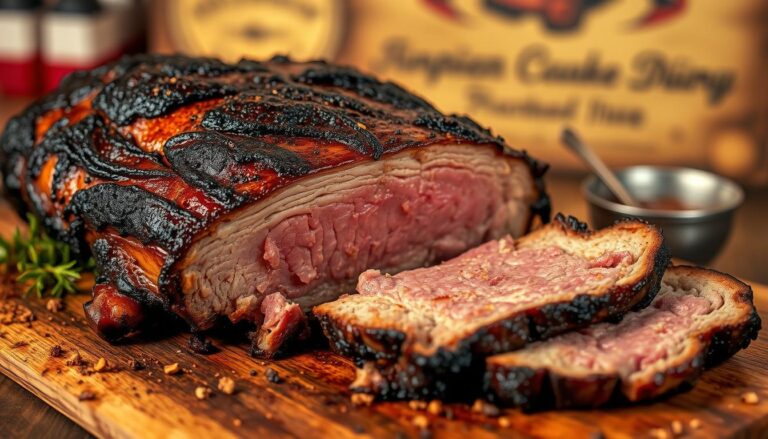
Brisket: Set the smoker to 225–275°F and aim for 195–205°F internal for Choice/Prime. Wagyu benefits from 205°F+. Plan about 1.5–2 hours per pound. A probe should slide in with very little resistance when done.
Pork shoulder (butt): Hold 225–250°F and pull at 195–205°F. Expect 1.5–2 hours per pound. Rest the roast to let juices redistribute before slicing or pulling.
Ribs, chicken, turkey, and salmon
Ribs: Run the pit at 225–250°F. Baby backs take ~5–6 hours; spares ~6–7. Target 190–205°F and use a tender probe feel or the bend test for doneness.
Poultry: Smoke chicken and turkey at 225–275°F. Pull breasts at 160°F and thighs at 180°F. Whole birds usually need 3–5 hours; turkey about 30–40 minutes per pound.
Salmon: Use a gentler 180–225°F. Pull at 135°F after roughly 30–45 minutes for silky texture and subtle smoke.
- Use both grate probes and instant‑read thermometers to track pit and internal values.
- Small fuel top‑offs and a modest water pan help steady air and heat for consistent flavor and bark.
- Avoid thick white smoke—thin blue smoke yields the best final taste.
Conclusion
,Locking down steady heat, clean blue smoke, and measured airflow delivers repeatable barbecue that tastes better every time.
Lean on reliable thermometers and smart monitors like FireBoard 2, ThermoWorks Signals, Weber Connect, or a BBQ Guru. Those tools stop fluctuations before they hurt results.
Fuel the fire with lump charcoal and quality wood chunks, use a modest water pan, and make tiny vent moves to meter oxygen and air. Seal doors, tidy ash, and plan times and hours realistically.
Practice, note settings, and be patient. When the smoker, heat, and smoke align, your flavor and texture will show the difference on every plate.